FoodTrace: farm-to-shelf provenance on Solana
The problem
A label that says "organic, from Green Valley Farm" is a claim, and the shopper has no way to check it. Supply chain records usually live in each company's own database, so anyone along the chain can edit their part after the fact. FoodTrace tries to make three things checkable by anyone holding the product:
- Who handled the batch at each stage (farm, processing, distribution, retail).
- That they were physically at the station when they recorded it.
- That the photo and details they recorded haven't been changed since.
How it works
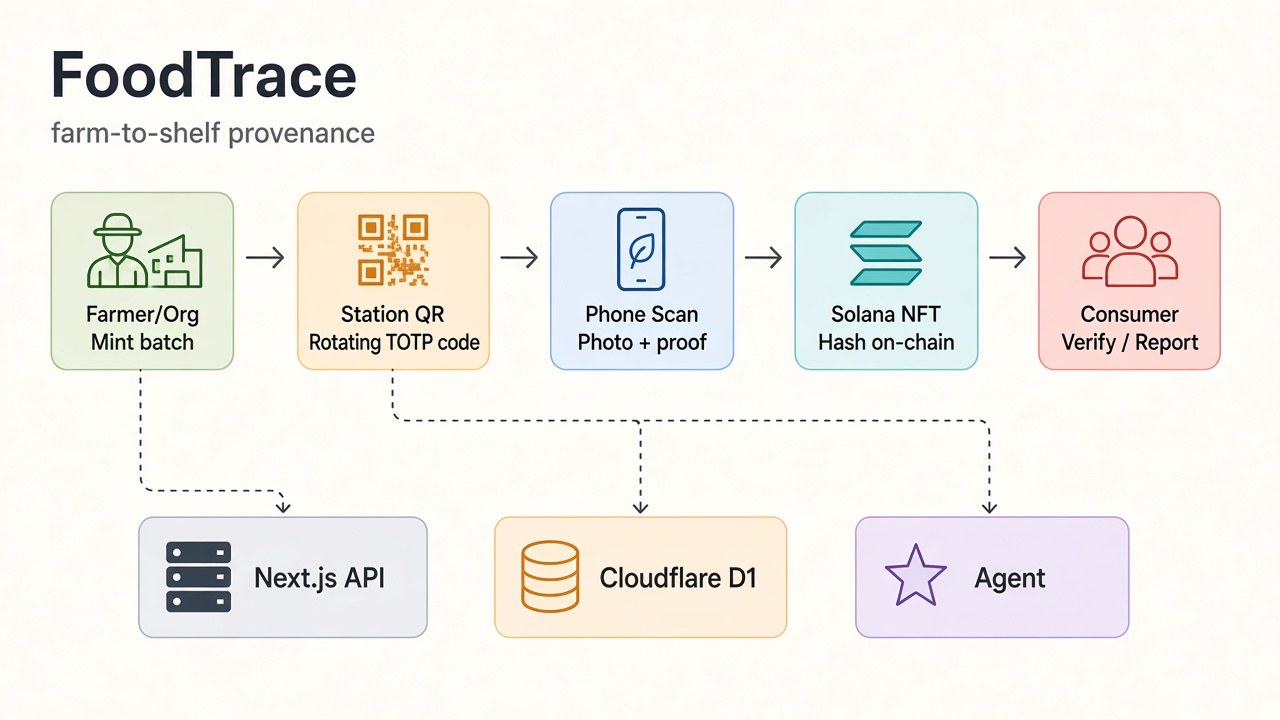
1. A farmer mints the batch
A farmer org logs in, names the product, and sets a location. The server mints a Metaplex Core NFT on Solana (devnet) for the batch. Its on-chain Attributes plugin starts with the batch ID, origin and creation time. The app prints a product QR code that points at the batch.
2. Each station shows a rotating code
Every stage has a station screen (/station/1 to /station/4) showing a QR code that
changes every 90 seconds. The code is a TOTP-style HMAC: HMAC-SHA256(secret, "stage:counter"),
where the counter is the current 90-second window, truncated to 8 hex characters. The server accepts the current
window and one on either side, to allow for clock drift and a slow scan, and compares codes in constant time.
A code is only valid for a few minutes, so a photo of the QR taken last week is useless. To record a stage, you have to be standing in front of the station screen. It's a cheap proof of presence with no special hardware.
3. A worker scans, photographs, submits
On their phone, a worker at the next org scans the station QR, then the product QR, then takes a photo of the shipment. Before submitting, a vision model checks the photo plausibly shows the claimed produce, even in boxes or crates. A hash only proves a photo hasn't been edited; it says nothing about what's in the frame.
The server then checks, in order:
- the org is logged in, and its role may record this stage (farmers record stage 1, processors stage 2, and so on);
- the station code is valid for this stage right now;
- stages happen in order: you can't record retail before distribution.
If everything passes, the server computes sha256 of the photo bytes. It also takes a snapshot of the org as it is
at that moment: role, certifications, location, and role-specific details like farming practice or refrigeration
type. The server hashes that snapshot too. The photo goes to Cloudflare R2 and the row to Cloudflare D1.
4. The fingerprint goes on-chain
The server appends an attribute to the batch NFT: stage:N = photoHash|timestamp|actor|snapshotHash.
That makes the NFT an append-only log of where the batch has been. The server refuses to write a stage that's already
on-chain, so editing a stage later shows up as a mismatch.
Solana confirmation from a Cloudflare Worker can take long enough that the transaction's blockhash expires first. So the submit returns immediately with a "pending" stage, and the chain write runs in the background. It retries with a fresh blockhash if it expires. If a retry fails but the attribute turns out to be on-chain anyway (the transaction landed before the confirmation timed out), it counts as a success.
5. Anyone can verify
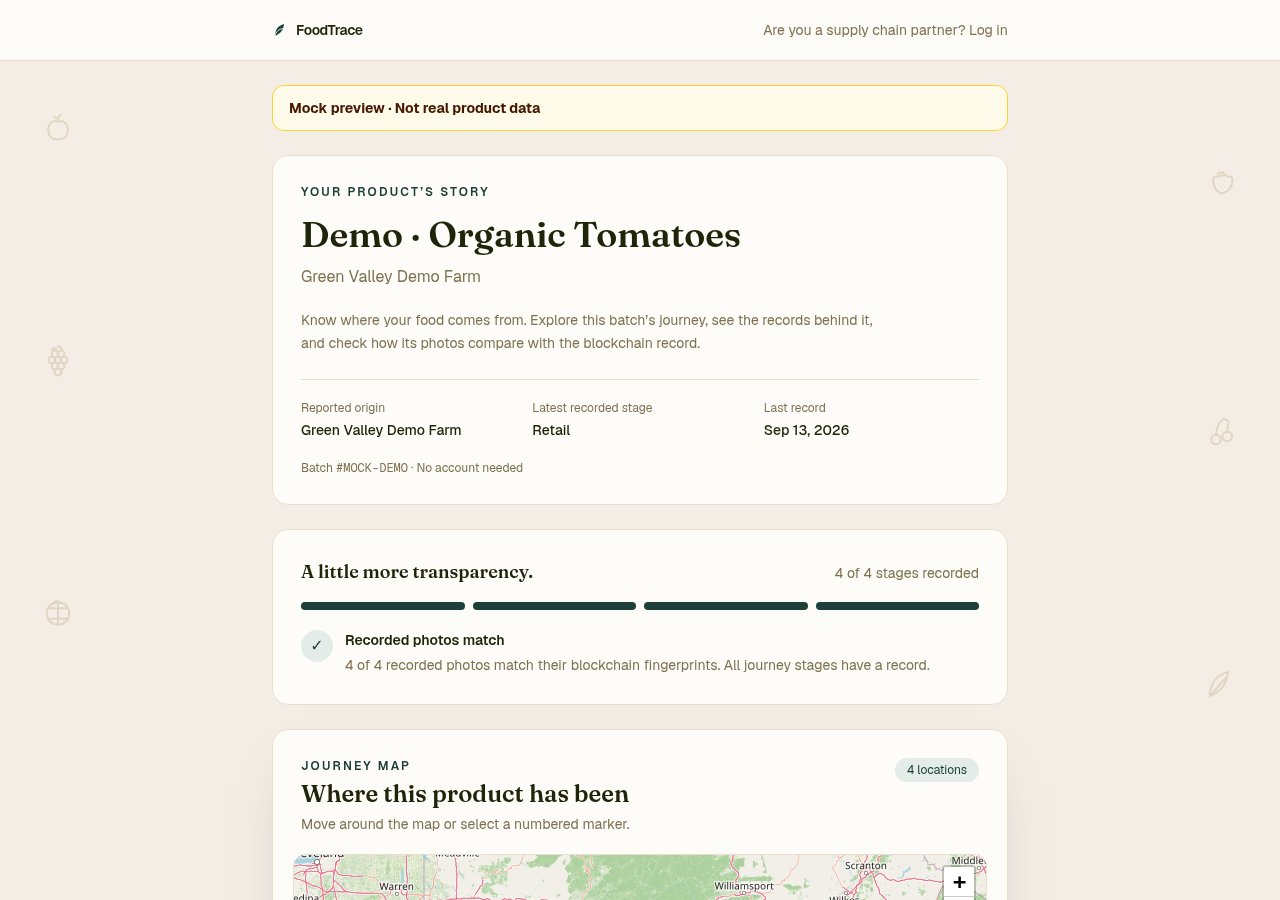
Scanning the product QR opens a public /verify/<batch> page, with no account needed. For each stage it:
- downloads the stored photo from R2 and re-hashes it;
- reads the NFT's attributes directly from Solana;
- compares the two, and does the same for the org snapshot hash.
If someone swaps a photo or edits a certification in the database, the hashes stop matching and the badge flips. The page also draws the batch's route on a journey map from the recorded locations, and links each stage to its transaction on a Solana explorer.
6. An AI product report
Each batch also gets a shareable product report. A tool-calling agent (Vercel AI SDK, IFM's K2 model) reads the batch, stages, org profiles and on-chain attributes through read-only tools. It then writes a schema-checked JSON report (Zod): a consumer-friendly origin story and journey, plus an auditor appendix with every hash and transaction. The prompt forbids inventing stages, orgs or hashes.
Reports are cached in D1 under a sha256 fingerprint of their inputs. The fingerprint covers only public
fields, and tests check that secret org fields never enter it. A report is regenerated only when the batch
actually changes. Generation streams the agent's tool calls to the page as it runs, so you can watch it work.
Stack
- App: Next.js, deployed to Cloudflare Workers through OpenNext; GitHub Actions runs lint,
tests and deploy on every push to
main. - Data: Cloudflare D1 (SQLite) for orgs, batches, stages and cached reports; R2 for photos.
- Chain: Solana devnet, Metaplex Core via Umi. Public devnet RPC returns 403 to Cloudflare Workers, so it uses MagicBlock's devnet RPC by default.
- AI: a vision model through OpenRouter for photo checks, and IFM K2 for reports.
My part
I mostly worked on the org and permissions layer:
- Org accounts with role-based permissions, covering which role can mint a batch and which stage each role may record, including splitting the original "supplier" role into processor and distributor.
- Org snapshots, which copy the org's location and role-specific fields onto each stage when it's recorded and put the snapshot's hash on-chain next to the photo hash. Editing an org's profile later can't rewrite history, and the verify page can prove it.
- Replacing station display keys with a station picker in the UI, gating the dashboard behind login, and a batch of mobile and dark-mode fixes for the scan flow.
Teammates built the D1/R2 migration, the Cloudflare deploy, the Solana retry and recovery logic, the report agent, the customer journey map, and the photo validation.
What I'd change
- Anyone who can see the screen, or a live photo of it, can record a stage, so proof of presence is only as good as the station screen. Signing with a key held by the station device, or checking phone GPS against the station's location, would tighten it.
- One server keypair writes every stage, so the chain proves the server recorded a hash, not which org did. Having each org sign its own stage would remove that trust in the operator.
- Each stage update rewrites the whole attribute list. That's fine for four stages, but a real supply chain would want an append-only account or compressed records.